How to Open a Private Clinic in the Philippines: The Complete Regulatory Roadmap (2026 Edition)
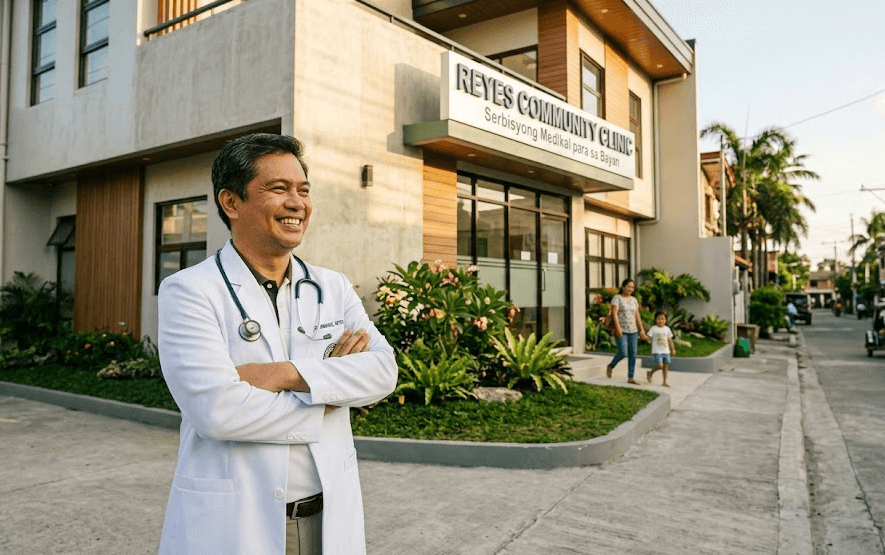
A specific question lands in our inbox every week from doctors finishing fellowship: “What exactly do I need to legally open my clinic? In what order? And how much will it cost?”
The answer, surprisingly, is hard to find written down clearly anywhere. PH government websites are scattered across DOH, BIR, LGU, PhilHealth, and SSS portals. Generic SME guides don't address medical practice specifics. Doctor finance content tends to focus on the financial side and skip the regulatory plumbing. And the regulatory landscape has shifted meaningfully in the last two years — RA 11976 eliminated the BIR Annual Registration Fee in 2024, PhilHealth renamed Konsulta to YAKAP in 2026, and DOH licensing requirements for primary care facilities now operate under a different administrative order than they did pre-pandemic.
This article is the operational manual we wish every fellow had a chance to read in their final year of training. We'll walk through every regulatory layer a Filipino doctor needs to legally open and operate a private clinic — the personal credentials, the LGU permits, the BIR registrations, the DOH licensing nuance (which most articles get wrong), the PhilHealth and HMO accreditations, and the SSS/PhilHealth/Pag-IBIG employer registrations if you'll be hiring staff.
You'll also get realistic 2026 cost ranges for three clinic profiles (lean solo, properly-equipped specialty, procedure-heavy specialty), a 90-day setup timeline, and the most common preventable mistakes.
This is general guidance. Specific requirements vary by city and by the specific services your clinic will offer. Always verify with your local Revenue District Office (RDO), Business Permits and Licensing Office (BPLO), and DOH Regional Office. But by the end of this article, you'll know exactly what to ask, in what sequence, and what each piece costs.
The mental model: seven regulatory layers
Before sequencing, it helps to see the whole picture. Opening a clinic in the Philippines isn't one process — it's seven interlocking ones, and the order matters because each layer typically requires documents from the previous layer.
The seven layers, in operational sequence:
- Personal credentials — Your PRC license, PTR, board certification, specialty society membership
- LGU permits — Barangay clearance, sanitary, fire, zoning, occupancy, Mayor's permit
- BIR registration — TIN update, Form 1901/1903, books of accounts, Authority to Print (ATP), Certificate of Registration (Form 2303)
- DOH licensing (if applicable) — License to Operate (LTO) for clinics with ancillary services
- PhilHealth accreditation (if applicable) — As individual physician and/or as institution (YAKAP Clinic if applying for primary care)
- HMO accreditations — Per HMO, separate processes
- Employer registrations (if hiring staff) — SSS, PhilHealth-employer, Pag-IBIG, ECC
Each layer has timelines, costs, document prerequisites, and renewal cycles. Most failures to launch on time come from misordering them — applying for the Mayor's permit before securing the lease, or trying to get HMO accreditation before having the BIR Certificate of Registration. We'll cover the right sequence below.
Layer 1: Your personal credentials (mostly already complete)
By the time you're opening a clinic, you should already have most of these. Worth confirming each is current.
PRC license. Your Professional Regulation Commission license to practice medicine. Renewed every three years; current renewal fee is approximately ₱600. You also need 60 CPD units per renewal cycle (medicine; other professions have different requirements). Your PRC license number will appear on every permit and accreditation document downstream — confirm it's not expired before starting the setup process.
Professional Tax Receipt (PTR). Issued by the LGU where you principally practice. Required of every licensed professional. Cost is around ₱300 annually. The PTR number will be requested on your BIR registration and on most professional documentation.
Specialty board certification. Required for HMO accreditation and for hospital affiliation as a specialist. If you've finished fellowship, you should have this. If you finished training but haven't sat for boards, prioritize this before clinic launch.
Specialty society membership. PMA + your specific specialty society (PCP for internists, PSO-HNS, POGS, PPS, PDS, etc.). Annual dues vary by society, typically ₱5,000–₱15,000. Required for credentialing with most HMOs and tertiary hospitals.
Malpractice insurance. Optional but increasingly expected by HMOs and corporate clients. Filipino professional indemnity premiums for physicians range from ₱15,000–₱50,000 annually depending on specialty and coverage limit. Procedural specialties (surgery, OB-GYN, anesthesia) pay higher; cognitive specialties pay lower.
Layer 2: LGU permits (the bottleneck)
LGU permits are usually the rate-limiting step in clinic setup. They're issued by your local city or municipal government, and they require a physical address, a signed lease (or proof of property ownership), and a sequence of clearances that build on each other.
The basic LGU stack, in order:
1. Barangay Business Clearance. First clearance in the sequence. Issued by the barangay where your clinic will operate. Requires lease contract, proof of identity, location sketch, and barangay fees. Cost typically ₱500–₱2,000 depending on barangay. Processed in 1–3 working days.
2. Locational/Zoning Clearance. Confirms your clinic location is zoned for commercial-medical use. Issued by the city/municipal Zoning Office. Some locations (residential zones, near schools, etc.) may require variance applications. Cost ₱500–₱3,000. Processed in 3–10 working days.
3. Sanitary Permit. Issued by the city/municipal Health Office. Inspector visits the clinic to verify it meets sanitation standards (water supply, waste disposal, ventilation, etc.). Cost ₱500–₱2,500. Also includes a Health Certificate ID for each clinic staff member (chest X-ray, drug test, urine, stool — about ₱500–₱1,500 per staff member). Processed in 3–7 working days.
4. Fire Safety Inspection Certificate (FSIC). Issued by the Bureau of Fire Protection. Inspector verifies fire safety equipment (extinguishers, emergency exits, signage). Cost ₱500–₱2,500 depending on clinic floor area. Processed in 3–10 working days. This is often the slowest LGU clearance.
5. Occupancy Permit. Required if your clinic is in a newly-constructed building or has undergone significant renovation. Issued by the City/Municipal Engineer's Office. Cost ₱1,000–₱5,000. Can take 2–4 weeks if structural inspections are needed.
6. Mayor's Permit / Business Permit. The final LGU step. Issued by the Business Permits and Licensing Office (BPLO). Requires all the clearances above plus your BIR Certificate of Registration (chicken-and-egg note below). Cost for a small clinic: typically ₱5,000–₱15,000 first year, depending on capital and projected gross.1 Renewed annually before January 20.
Important sequencing note: the BIR-LGU chicken and egg. Some LGUs require BIR registration before issuing the Mayor's Permit. Other LGUs require the Mayor's Permit before you can complete BIR registration. The practical workaround: in most cities, you submit a barangay clearance and an application receipt to BIR to start their registration, then bring your BIR Certificate of Registration back to BPLO to finalize the Mayor's Permit. Confirm the local sequence at your specific BPLO before starting.
Annual renewal. All LGU permits expire December 31 each year. Renew by January 20 of the following year, or face 25% surcharge and 2% monthly interest on the unpaid renewal fees.2 The renewal package (Mayor's + barangay + sanitary + fire) typically costs ₱8,000–₱20,000 per year for a small clinic.
Layer 3: BIR registration (do this right the first time)
The BIR registration sequence determines your tax position for the lifetime of the practice. Mistakes here compound for years. Do it deliberately.
Step 1: Update your TIN registration. If you're already in BIR records as a hospital employee under one TIN, you don't get a second TIN — you update your existing registration to add self-employment/professional income. File BIR Form 1905 with your current Revenue District Office (RDO) to transfer or add a new registration type.
Step 2: File BIR Form 1901 (for sole proprietors) or 1903 (for corporations). This formally registers your medical practice as a business. You'll need: TIN, PRC license, PTR, barangay clearance, lease contract (proof of business address), valid government ID, and the filing fee. No filing fee for the form itself.
Step 3: BIR Annual Registration Fee — eliminated. Important update: the ₱500 Annual Registration Fee (BIR Form 0605) was abolished by RA 11976, the Ease of Paying Taxes Act, effective January 22, 2024.3 If anyone — including a Revenue Officer at your RDO — asks you to pay this fee, the requirement no longer applies. Many outdated articles online still list this fee. It's gone.
Step 4: Register your Books of Accounts. Required to maintain BIR-compliant accounting records. Three formats are available:
- Manual books (handwritten ledgers) — cheapest at ₱500–₱1,500 for the books themselves plus BIR stamping. Tedious for any clinic with meaningful volume.
- Loose-leaf books (computer-printed binders) — most common for solo and small clinics. ₱1,500–₱5,000 setup. Requires annual permit renewal.
- Computerized Accounting System (CAS) — requires BIR Form 1907 approval, which can take 4–12 weeks. Suited for multi-clinic practices.
Step 5: Authority to Print (ATP) and Official Receipts. Required before you can legally issue receipts to patients. File BIR Form 1906 with your RDO, naming a BIR-accredited printer. The printer produces your Official Receipts (ORs) and Sales Invoices (if VAT-registered) in BIR-prescribed format. Typical cost for first batch: ₱2,000–₱5,000 for 5–10 booklets. Processing time: 2–4 weeks from filing to receiving printed receipts.
Step 6: Certificate of Registration (BIR Form 2303). This is your formal proof that the BIR recognizes your medical practice. You'll need to post the original in your clinic. Required for HMO accreditation, hospital affiliation, bank account opening, and almost every downstream registration.
Step 7: Elect your tax regime. When you file your first quarterly return (1701-Q), you elect either the 8% optional tax or the graduated tax rates. This election is locked for the entire tax year and is one of the most consequential decisions in clinic setup. The election depends on your projected gross income, expense profile, and whether you have mixed income from hospital employment. (We covered the framework in The 7 Most Expensive Tax Mistakes Filipino Doctors Make and the regime-specific nuance in the mixed income guide.)
Total BIR registration cost: ₱5,000–₱15,000 for a solo clinic. Mostly admin fees, printer fees, and minor processing costs.
Layer 4: DOH licensing — the nuance most articles get wrong
This is where most existing guides get confused. The question “Does my clinic need a DOH License to Operate?” has a more specific answer than typically published, and getting it wrong wastes either months of unnecessary processing time or exposes you to compliance risk on the other side.
The general rule
For a solo physician's clinic offering only outpatient consultation and basic in-clinic procedures within the physician's specialty — no laboratory services, no X-ray, no ambulatory surgical procedures, no dispensing of medicines, no birthing or infirmary services — DOH licensing is generally not required. The PRC license of the physician is the primary operational authority. Your LGU permits handle the business-operations side.
When DOH licensing IS required
DOH licensing becomes mandatory when your clinic operates as, or includes, any of the regulated facility categories under the DOH One-Stop Shop (OSS) Licensing System or under DOH Administrative Order 2020-0047 governing Primary Care Facilities:4
- Clinical laboratory — Any in-house lab beyond point-of-care testing requires a DOH-licensed clinical laboratory permit under DOH AO 2021-0037.
- Medical X-ray facility — Any X-ray equipment requires a permit from the DOH Bureau of Health Devices and Technology (BHDT). Radioactive material adds Philippine Nuclear Research Institute (PNRI) coordination.
- Ambulatory Surgical Clinic — Any clinic performing surgical procedures requiring anesthesia (general, regional, or major sedation) needs an Ambulatory Surgical Clinic LTO. Local-anesthesia minor procedures within outpatient consultation typically don't trigger this.
- Dialysis clinic — Separate DOH licensing.
- Birthing home or lying-in clinic — Separate DOH licensing under specific BHFS regulations.
- Infirmary — Any overnight patient stay capacity requires infirmary licensing.
- Pharmacy / Drug-dispensing — FDA license required in addition to (or instead of) DOH coordination, depending on scope.
- Primary Care Facility (PCF) — If you intend to register as a designated Primary Care Facility under the Universal Health Care Act (RA 11223), DOH AO 2020-0047 applies. This is typically relevant if you want to be designated as a PhilHealth YAKAP Clinic (see Layer 5 below).
Specialty-specific guidance
- Cognitive specialists (Internal Medicine, Cardiology, Endocrinology, Pediatrics, Neurology, etc.) running a consultation-only clinic: typically no DOH LTO needed.
- OB-GYN with in-clinic ultrasound: ultrasound itself doesn't trigger DOH LTO (it's not classified as a medical X-ray facility), but if you provide laboratory services or birthing services, separate licensing applies.
- Dermatology with cosmetic procedures: most laser and topical procedures don't require DOH LTO, but procedures involving major anesthesia or surgical excision in dedicated procedure rooms may trigger Ambulatory Surgical Clinic licensing.
- Ophthalmology with diagnostic equipment (OCT, fundus camera): generally no LTO; but in-clinic surgical procedures or refractive surgery require Ambulatory Surgical Clinic licensing.
- Surgery (general, plastic, orthopedic, ENT, urology): if you operate in your own clinic with anesthesia, Ambulatory Surgical Clinic LTO is required. If you only consult in clinic and operate in hospital ORs, no LTO needed for the clinic.
- Pathology, Radiology, Laboratory Medicine: yes, DOH-licensed clinical lab is mandatory.
Cost of DOH LTO when applicable: ₱10,000–₱50,000 depending on category, plus possible Permit to Construct fees if a new facility is being built. Processing takes 2–6 months in most cases.
Most common mistake: Solo specialists going through unnecessary DOH LTO application processes because a friend or accountant assumed it was required. Confirm with your local DOH Center for Health Development (CHD) Regional Office whether your specific clinic configuration requires LTO before starting the application.
Layer 5: PhilHealth accreditation (YAKAP, formerly Konsulta)
PhilHealth accreditation is optional but increasingly important if you want to bill PhilHealth for patient services or participate in the Universal Health Care primary care expansion.
Two accreditations exist, and they're separate:
Individual physician accreditation. As a PRC-licensed doctor with a valid PhilHealth provider number, you can claim PhilHealth benefits for procedures performed on PhilHealth members in your clinic — even without separate facility accreditation. This is the simpler path for most specialist practices. Required documents: PRC license, certificate of specialty board, valid IDs, completed PhilHealth Provider Data Record.
Facility accreditation as a YAKAP Clinic (formerly Konsulta).5 If your clinic provides primary care services and you want to participate in PhilHealth's primary care expansion under the Universal Health Care Act, you can apply for YAKAP Clinic accreditation. YAKAP is the renamed and expanded Konsulta program — the eKonsulta system was retired in July 2026 and replaced with a new EMR-integrated YAKAP framework.
Key requirements for YAKAP accreditation:
- DOH License to Operate as a Primary Care Facility (per DOH AO 2020-0047)
- PhilHealth-certified electronic medical record (EMR) system
- Performance Commitment (notarized)
- List of physicians providing primary care services
- Service Delivery Support certificates for laboratory, diagnostics, and medicines (if not directly provided)
- Mayor's Permit (or, if located in a private corporation/school, the host's Mayor's Permit)
- For partnerships/corporations: updated General Information Sheet (GIS)
Renewal window for existing YAKAP clinics: October 1 through the last working day of December each year. New applications can be filed anytime.
For specialist clinics: YAKAP accreditation typically isn't relevant if you're not offering primary care services. Most specialists rely on individual physician accreditation for PhilHealth claims and skip facility accreditation entirely.
Layer 6: HMO accreditations (the patient-flow gateway)
Each major HMO has its own accreditation process. The Philippines has roughly 15–20 active HMOs, with the largest five (Maxicare, MediCard, Intellicare, ValuCare, PhilCare) covering the majority of corporate-insured patients.
Typical HMO accreditation requirements:
- PRC license + specialty board certification
- Certificate of Membership in your specialty society
- BIR Certificate of Registration (Form 2303)
- Mayor's Permit
- Lease contract or proof of clinic ownership
- Two recent passport-sized photos
- Curriculum vitae
- Three professional references
- Malpractice insurance (some HMOs require, most prefer)
- Performance Commitment / Accreditation Agreement
Process timing: Each HMO takes 6–12 months from application to active accreditation. This is the slowest moving part of clinic setup, which is why we recommend starting HMO applications 4–6 months before you finish training (where institutionally permissible) rather than after the clinic is operational.
Cost: Most HMO accreditations are free or have nominal admin fees. The cost is time and documentation effort.
Strategic note on HMO selection: Don't apply to all 20 simultaneously. Pick the 3–5 HMOs that have the highest local penetration in your clinic's catchment area. Maxicare and MediCard typically dominate corporate insurance in Metro Manila. Regional HMO penetration varies; ValuCare and Caritas Health Shield are strong in specific regions. Ask senior consultants in your area which HMOs produce the most referrals for your specialty.
Layer 7: Employer registrations (only if you'll hire staff)
If your clinic will employ a secretary, nurse, or other regular staff, you become an employer under PH labor law and must register with four agencies:
SSS (Social Security System) — Employer Registration. Required within 30 days of hiring your first regular employee. File SSS Form R-1 (Employer Data Record) and R-1A (Initial List of Employees). Employer contribution rate is 9.5% of monthly salary credit (employer share) plus 4.5% (employee share, withheld) as of 2026. Monthly remittances due by the last day of the following month.
PhilHealth-Employer Registration. Separate from your individual PhilHealth physician number. Register as an employer using PhilHealth Form ER1. Employer contribution rate: 5% of monthly salary (split between employer and employee).
Pag-IBIG (HDMF) — Employer Registration. Register your clinic as a Pag-IBIG employer. Mandatory contribution: 2% of monthly salary (employer share) plus 2% (employee, withheld).
ECC (Employees' Compensation Commission). Registered automatically when you register with SSS. Provides work-injury insurance for employees. Employer remits ₱10/month for employees earning under ₱14,500 and ₱30/month for those above.
Total monthly employer-side overhead beyond gross salary: Approximately 11–13% of each employee's gross pay. Budget for this in your clinic cash flow projections.
The realistic cost breakdown: three clinic profiles
Setup costs vary dramatically based on specialty and clinic scale. Three representative profiles:
Profile A — Lean Solo Clinic (Cognitive Specialist)
Typical for: New Internal Medicine, Pediatric, Endocrine, or other cognitive specialist with no procedural component. Single-room clinic, 30–40 sqm, in a hospital arcade or medical building.
One-time setup costs:
- Lease deposit (2 months) + first month: ₱60,000–₱120,000
- Renovation / fit-out (minimal): ₱80,000–₱200,000
- Furniture (desk, chairs, exam table, cabinets): ₱30,000–₱80,000
- Basic equipment (BP apparatus, stethoscope, otoscope, weighing scale, thermometer, basic exam kit): ₱30,000–₱80,000
- Computer + printer + EMR/scheduling software: ₱30,000–₱70,000
- Signage: ₱5,000–₱20,000
- Initial supplies: ₱10,000–₱30,000
- LGU permits package (Mayor's + barangay + sanitary + fire + zoning): ₱8,000–₱20,000
- BIR registration + books + ATP + receipts: ₱5,000–₱15,000
- 3-month operating reserve: ₱150,000–₱300,000
Total Profile A setup: ₱400,000 to ₱950,000
Profile B — Properly-Equipped Specialty Clinic
Typical for: OB-GYN with ultrasound, Cardiology with echocardiogram, Dermatology with light-based procedures, Ophthalmology with diagnostic equipment. 50–80 sqm with separate examination and procedure space.
One-time setup costs (in addition to Profile A baseline):
- Larger lease deposit + first month: ₱100,000–₱200,000
- More substantial fit-out (separate exam + procedure rooms): ₱250,000–₱600,000
- Specialty equipment (ultrasound for OB ₱400K–₱1.5M; ECG/echo for cardio ₱200K–₱600K; light/laser for derma ₱400K–₱1M; slit lamp + tonometer for ophtha ₱200K–₱500K): ₱200,000–₱1,500,000
- Higher furniture grade: ₱80,000–₱150,000
- Comprehensive supplies and consumables: ₱30,000–₱80,000
- 3-month operating reserve (larger overhead): ₱300,000–₱500,000
Total Profile B setup: ₱1,000,000 to ₱2,500,000
Profile C — Procedure-Heavy Specialty Clinic
Typical for: Multi-modality dermatology cosmetic, ENT with audiometry and endoscopy, Gastroenterology with endoscopy, Orthopedic surgery with minor procedures, certain ASC-classed surgical practices. 80–120+ sqm with dedicated procedure and recovery rooms.
One-time setup costs:
- Premium location, larger space: ₱200,000–₱400,000 lease + deposit
- Extensive fit-out (multiple rooms, plumbing, electrical for medical equipment): ₱500,000–₱1,500,000
- Major procedural equipment: ₱500,000–₱5,000,000+
- DOH Ambulatory Surgical Clinic LTO (if applicable): ₱25,000–₱100,000 in fees and processing costs
- Additional medical-grade furniture and exam equipment: ₱150,000–₱300,000
- Larger initial supply stock (consumables for procedures): ₱80,000–₱200,000
- 6-month operating reserve (higher overhead, longer ramp): ₱600,000–₱1,200,000
Total Profile C setup: ₱2,500,000 to ₱8,000,000+
Recurring monthly operating costs (across all profiles)
- Rent: ₱20,000–₱80,000 (modest location) to ₱100,000–₱250,000 (premium)
- Utilities: ₱5,000–₱20,000
- Staff salaries: ₱18,000–₱30,000 per secretary; ₱25,000–₱45,000 per nurse; plus 11–13% employer-side mandatory contributions
- Consumables and supplies: ₱5,000–₱20,000
- EMR/software subscriptions: ₱2,000–₱10,000
- Internet and telecom: ₱2,000–₱5,000
- Liability insurance amortized: ₱1,500–₱4,500
- CPA and accounting services: ₱5,000–₱25,000
Recurring annual fixed costs (independent of monthly):
- Mayor's permit renewal package: ₱8,000–₱20,000
- Sanitary and fire renewal: ₱2,000–₱8,000
- PRC renewal (every 3 years): ₱600 (₱200/year amortized)
- PMA + specialty society dues: ₱5,000–₱15,000
- Malpractice insurance: ₱15,000–₱50,000
- CME/CPD requirements (60 units per 3-year cycle): ₱20,000–₱100,000
The realistic 90-day setup timeline
For a typical Profile A or B clinic, here's the operational sequence and timing if you start from scratch:
Days 1–7 — Pre-launch decisions. Finalize specialty positioning, target patient mix, expected gross revenue, and structure (sole proprietor vs OPC). Confirm specialty-specific DOH requirements with your CHD Regional Office.
Days 8–21 — Location selection and lease. Identify and visit at least 5 prospective locations. Verify zoning is appropriate. Sign month-to-month or 6–12 month lease (avoid long-term leases in Year 1).
Days 15–30 — Initial LGU clearances and BIR registration filing. Apply for barangay clearance, zoning, locational permit. Begin BIR Form 1901/1903 application. Order books of accounts. File Authority to Print (ATP).
Days 22–45 — Renovation and equipment procurement. Fit-out begins. Order furniture and equipment. Hire and onboard clinic staff. Apply for SSS, PhilHealth-employer, Pag-IBIG registrations if hiring.
Days 30–60 — Sanitary and fire inspections. Schedule inspections after fit-out is largely complete. Address any compliance issues. Pay applicable fees.
Days 45–60 — Mayor's permit issuance. Submit complete package to BPLO. Receive Business Permit and Business Plate.
Days 55–75 — DOH LTO (if applicable; runs in parallel; can extend beyond 90 days for some categories).
Days 60–75 — HMO accreditation applications. Submit to your priority 3–5 HMOs. Accreditation will continue beyond clinic opening; first HMO patient referrals typically arrive in months 4–8.
Days 60–90 — Soft launch and ramp-up. Print marketing materials. Update Google Maps / hospital directories / social media. Begin seeing patients. Track first 60 days of cash flow against projections.
Days 90+ — Optimization. First quarterly 1701-Q filing due by May 15 if you start clinic operations before April; otherwise the first quarter you operate. Adjust staffing, pricing, hours based on first 90 days of operational data.
Common preventable mistakes
The mistakes that delay launches or create downstream pain are usually preventable. The top patterns:
1. Signing a long-term lease before validating patient flow. Year 1 patient flow is the riskiest variable in clinic economics. A 3-year lease at a location that doesn't produce traffic can lose ₱500,000+ before you can exit. Sign short.
2. Starting BIR registration after Mayor's permit application. These need to run in parallel, not sequentially. Most LGUs require a BIR Certificate of Registration to finalize the Mayor's Permit, while BIR registration typically requires a barangay clearance. Build the sequence backwards from the dependencies before starting.
3. Underestimating renovation cost. Filipino clinic fit-outs routinely run 30–50% over initial contractor estimates. Add a 25% buffer to whatever your contractor quotes.
4. Skipping books of accounts registration. The most common BIR exposure point we see in established practices. Doctors who didn't register loose-leaf books in Year 1 face penalties at every BIR audit, plus the technical requirement to reconstruct prior years' records when discovered.
5. Applying for DOH LTO when not required. Solo specialists frequently apply for DOH LTO when their clinic configuration doesn't require it, losing 3–6 months of unnecessary processing and ₱15,000–₱40,000 in fees and consultant costs. Confirm at your CHD before applying.
6. Hiring staff before completing employer registrations. Hiring your first staff member before completing SSS/PhilHealth/Pag-IBIG registrations triggers retroactive penalty exposure plus DOLE compliance issues. Complete the employer registrations first, then hire.
7. Not separating personal and clinic finances from Day 1. Mixing creates an audit liability that grows month over month. Open a separate clinic bank account before issuing your first OR.
8. Underestimating ramp time. Most new clinics produce net losses or near-zero net income for the first 6–12 months while patient flow builds. Plan capital reserves accordingly. (We covered the full first-five-year arc in The Financial Anatomy of a Filipino Doctor's First Five Years in Private Practice.)
A free Clinic Setup Checklist for Filipino doctors
We've built a printable Clinic Setup Checklist — a single-page PDF covering every regulatory layer above, with checkbox tracking for each permit/registration, the estimated cost range, the typical processing time, and the prerequisite document for each. Designed to sit on your desk through the setup process and track your launch progress.
Drop your email and we'll send it free →
Opening a private clinic in the Philippines isn't conceptually complicated. It's just procedurally dense. Seven layers, each with its own documents, fees, timelines, and renewal cycles. Most launch delays come from misordering the steps; most ongoing compliance issues come from skipping foundation work in the first 90 days.
If you're at the point of planning your clinic launch — whether it's three months out or eighteen months out — we offer a free 30-minute review for Filipino doctors. We'll walk through your specific specialty, location plan, BIR strategy, and projected timeline, and tell you exactly what to do in what order. No commitment, no pitch. Just a clear-eyed read on the sequence that will make your launch smooth instead of chaotic.
Footnotes
- Respicio & Co. Law Firm. “Business Permit Costs in the Philippines: Fees, Requirements, and Processing Time.” Published February 19, 2026. Annual Mayor's Permit fees for small businesses (including small clinics) typically range from ₱5,000 to ₱15,000, covering Mayor's Permit fee, business tax (based on capital or gross sales), garbage fee, sanitary fee, fire safety fee, and other LGU regulatory charges. Specific fees vary by LGU under Republic Act No. 7160 (Local Government Code). ↩
- Wise Business. “Your 2025 Guide to Business Permit Renewal in the Philippines.” Both Mayor's Permit and Barangay Permit expire on December 31 each year and must be renewed by January 20 of the following year. Late renewal triggers a 25% surcharge on all unpaid taxes, charges, and fees, plus 2% monthly interest on outstanding amounts. ↩
- Republic Act No. 11976 (Ease of Paying Taxes Act), signed into law January 5, 2024 and effective January 22, 2024. The law repealed Section 236(B) of the National Internal Revenue Code, eliminating the ₱500 Annual Registration Fee (BIR Form 0605) previously required of all BIR-registered taxpayers. BIR Certificates of Registration issued before this date remain valid indefinitely without annual renewal. ↩
- Department of Health Administrative Order No. 2020-0047, “Rules and Regulations Governing the Licensure of Primary Care Facilities in the Philippines,” issued pursuant to Republic Act No. 11223 (Universal Health Care Act). Establishes licensing standards and requirements for private and government Primary Care Facilities (PCFs). Most solo specialist physician clinics offering only outpatient consultation operate under PRC licensure without DOH LTO; DOH licensing becomes mandatory when the clinic includes regulated ancillary services or seeks PCF designation. Verify specific requirements with your DOH Center for Health Development (CHD) Regional Office. ↩
- Philippine Health Insurance Corporation Advisory No. 2025-0055, “Renewal of Accreditation of Health Facilities for Calendar Year 2026,” published October 6, 2025. Under PhilHealth Circular 2023-0012, the period for filing renewal applications for CY 2026 was October 1 to December 29, 2025. The PhilHealth Konsulta program was renamed to YAKAP (formerly Konsulta), with the eKonsulta system retired in July 2026 and replaced with EMR-integrated YAKAP framework. Existing Konsulta accreditations were automatically transitioned to YAKAP without re-application. ↩
Share this article
Found this useful?
Know a doctor planning to open their own clinic? This is the regulatory roadmap we wish every fellow had before their first permit application.
Comments
Loading comments…
Magat CPA
Free 30-minute clinic launch review
We'll walk through your specific specialty, location plan, BIR strategy, and projected timeline — and tell you exactly what to do in what order. No commitment, no pitch.
Alvin Magat, CPA, CIA, REB, MDP
Alvin is a Certified Public Accountant, Certified Internal Auditor, PRC-licensed Real Estate Broker, and Management Development Program graduate based in the Philippines. He founded Magat CPA to serve Filipino doctors exclusively — because specialization compounds, and physicians deserve accountants who actually understand clinic setup, mixed-income reporting, and the BIR's particular interest in high-earning professionals.
This article is general guidance current as of mid-2026; specific requirements vary by city, by clinic configuration, and by changes in BIR, DOH, LGU, and PhilHealth regulations. Always verify current requirements with your local RDO, BPLO, DOH Regional Office (CHD), and PhilHealth Regional Office before initiating any permit or registration. This article is not a substitute for legal or accounting counsel for your specific situation.